Data Center
A non-blocking leaf-spine fabric you can cable once and grow into for years.
What the network looked like before we touched it.
A colocation and private-cloud operator outgrows top-of-rack switching that was bought one rack at a time. East-west traffic between hosts crosses too many hops, oversubscription bites during backups and live migrations, and adding a rack means re-thinking the whole topology instead of just plugging it in. The fabric has no clean way to scale.
Built to spec, once.
OKTET builds a two-tier leaf-spine on OKTET silicon: OS-4800 leaves at top of rack, OR-8000 spines in the core, every leaf connected to every spine over OF-SFP10 10/25GbE optics for a non-blocking, equal-cost-multipath fabric. Adding capacity means adding a leaf and four uplinks — the topology does not change. Any host is two hops from any other host, predictably.
Compare the hardware →non-blocking leaf-to-spine subscription
maximum host-to-host path, any rack
scaled with zero topology redesign
How the deployment actually went.
A colocation operator running a private OpenStack cloud alongside customer cages had built their data center network the way most people do: a pair of switches per rack, daisy-chained back to a core that had been “temporary” for three years. It worked until it did not. Live migrations and nightly backup windows pushed east-west traffic across four or five hops, oversubscription on the core uplinks turned predictable jobs into variable ones, and every new rack of customer hardware started a fresh argument about where to plug it in.
We replaced the ad-hoc topology with a textbook two-tier leaf-spine, all on OKTET silicon. Each rack tops out with an OS-4800 acting as a leaf; the core is a pair of OR-8000 spines; and every leaf connects to every spine with OF-SFP10 optics running 10 and 25GbE. The fabric is 1:1 non-blocking from leaf to spine, traffic is spread across all spine uplinks with equal-cost multipath, and any host is exactly two hops from any other host regardless of which rack it lands in. The cabling is uniform and documented, so the next rack is a known quantity.
The operator has since grown from 12 racks to 40 without a single topology redesign — adding a rack means racking one OS-4800 leaf and pulling four uplinks to the spines, nothing more. Backup windows stopped colliding with daytime performance because the fabric stopped oversubscribing under load. Capacity planning became arithmetic instead of architecture.
A leaf-spine fabric is not a new idea, and we do not pretend it is. The value is in building it to spec the first time — uniform leaves, uniform optics, a non-blocking ratio you can prove — so that growth is addition, not redesign.
The line that built it.

OKTET OS-4800
Forty-eight 10GbE ports and six 100G uplinks for the aggregation layer.
- Ports
- 48× SFP+ 10GbE · 6× QSFP28 100GbE
- Switching capacity
- 2.16 Tbps / 1,607 Mpps
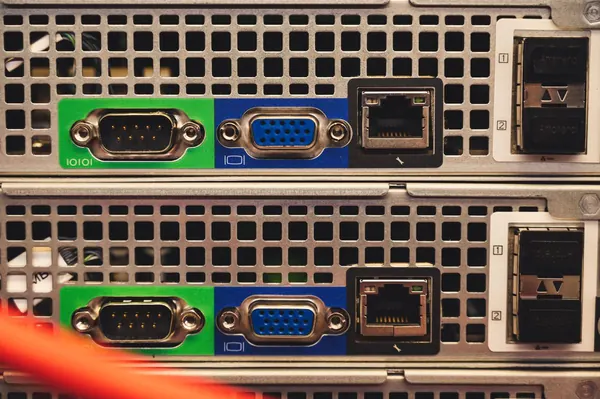
OKTET OR-8000
Enterprise edge routing and stateful firewall at 40 Gbps, line-rate where it counts.
- Throughput
- 40 Gbps firewall · 28 Gbps IPsec VPN
- Ports
- 8× SFP+ 10GbE · 2× RJ45 2.5GbE

OKTET OF-SFP10
A 10G optics and DAC family that's coded for OKTET and honest about reach.
- Form factor
- SFP+ (10GbE) · DAC / AOC
- Reach
- DAC 0.5–5 m · SR 300 m · LR 10 km
Specify it for your site.
Send us the constraints — rack count, building count, subscriber load — and we'll return a bill of materials sized to spec.