OS-4800
SKU OKT-OS4800 · From $3,480
Forty-eight 10GbE ports and six 100G uplinks for the aggregation layer.
- 2.16 Tbps non-blocking fabric — 48× 10G plus 6× 100G with zero oversubscription.
- QSFP28 uplinks break out to 4×25G, so one box serves spine or high-density leaf roles.
- Full L3 stack: BGP4, IS-IS, MLAG, and VXLAN/EVPN for fabric overlays.

Ports
48× SFP+ 10GbE · 6× QSFP28 100GbE
Switching capacity
2.16 Tbps / 1,607 Mpps
Management
Full L3 · BGP · CLI · REST
PoE
None (fiber aggregation)
Every number, published.
Interfaces
| Data ports | 48× SFP+ (10GbE / 1GbE) |
|---|---|
| Uplink ports | 6× QSFP28 (100GbE / 4×25GbE breakout) |
| Management port | 1× RJ45 10/100/1000 out-of-band |
| Console | 1× RJ45 RS-232, 1× USB-C |
| MAC address table | 512,000 entries |
| Routing table | 256,000 IPv4 / 128,000 IPv6 (FIB) |
Performance
| Switching capacity | 2.16 Tbps non-blocking |
|---|---|
| Forwarding rate | 1,607 Mpps (64-byte packets) |
| Packet buffer | 32 MB shared |
| Latency | < 900 ns (cut-through, 64B) |
| L3 protocols | OSPF, BGP4, IS-IS, ECMP, VRRP, MLAG |
| Overlay | VXLAN / EVPN, 16,000 VNIs |
Power & Environment
| Power supplies | 2× 600W hot-swap (1+1 redundant) |
|---|---|
| Typical draw | 214 W (48 ports loaded, DAC) |
| Cooling | 4+1 hot-swap fans, front-to-back |
| Operating temperature | 0 °C to 45 °C |
| MTBF | 298,000 hours (25 °C) |
| Form factor | 1U, 440 × 460 × 44 mm |
The front panel, to the octet.
Each interface is octet-numbered and colour-keyed by media. Hover a cell for its role.
- Fiber / SFP
- Copper / RJ45
- Console
Photographed as hardware.
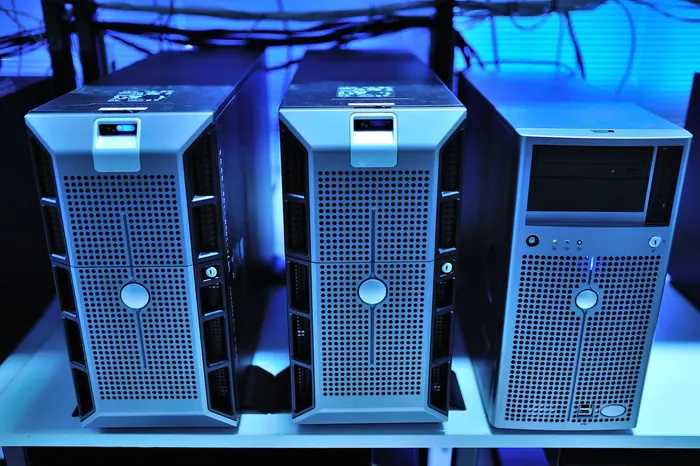

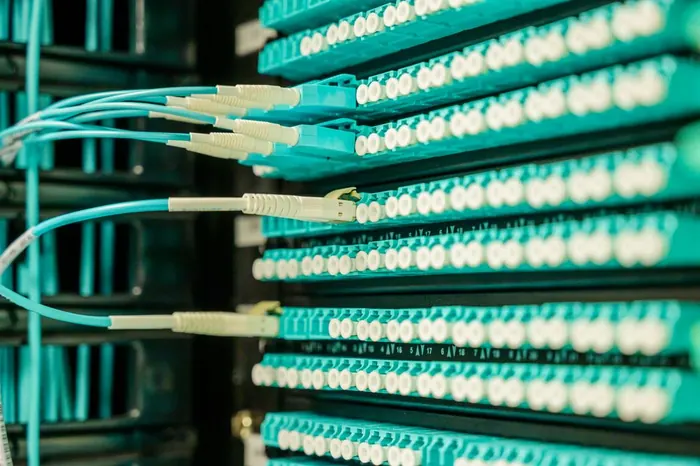
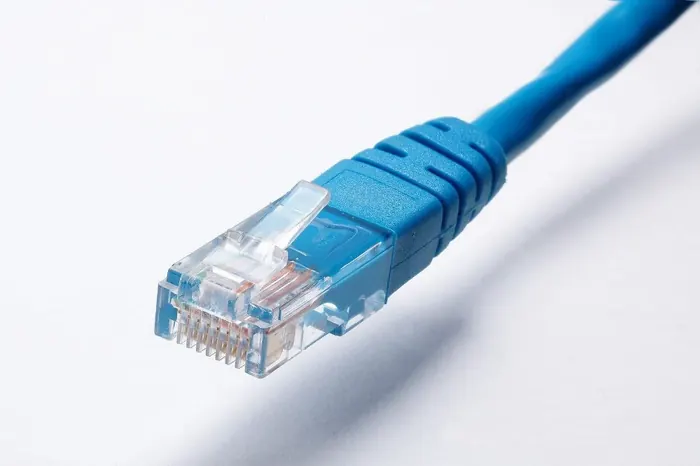
The OS-4800 sits one layer above the OS-2400: it is an aggregation and spine switch, sized for the point in a network where forty-eight access links converge and need to exit on 100G. The fabric is 2.16 Tbps, non-blocking, and the forwarding rate is 1,607 Mpps at 64-byte packets. The six QSFP28 ports run at 100GbE or break out to 4×25GbE each, so a single chassis can act as a spine, a high-density leaf, or a collapsed core depending on how you cable it.
This is the box where the full Layer-3 control plane lives. BGP4, OSPF, and IS-IS are all present; MLAG gives you active-active dual-homing without spanning-tree blocking; and VXLAN with EVPN carries up to 16,000 overlay segments for multi-tenant or stretched-L2 designs. The 32 MB shared packet buffer is sized deliberately for incast — the many-to-one bursts that storage clusters and distributed databases generate — rather than for a headline number.
Power is 1+1 redundant on 600W hot-swap supplies, cooling is 4+1 hot-swap fans, and everything is front-serviceable with front-to-back airflow. Typical draw under full DAC load is 214 W. Rated MTBF is 298,000 hours at 25 °C.
Deployment note: In a leaf-spine build, pair OS-4800 spines with OS-2400 leaves over the 25G breakouts; MLAG peer-links should use two dedicated QSFP28 ports (04 and 03 by convention) on direct DAC. The switch ships with EVPN disabled — enable it only after the underlay is verified, and bring up BGP sessions before layering the overlay. Optics and breakout cables are ordered via OF-SFP10.
Spec it against the rest of the line.
Drop the OS-4800 into the Network Builder, or browse the full catalog.
OKT-OS4800 · OKTET — INFRASTRUCTURE, TO SPEC.